Removing Infrastructure Barriers in Human-Robot Collaboration Through Wireless Reconfigurable Cells
The authors develop and evaluate a wireless, 5G-connected reconfigurable workcell for human-robot collaboration featuring edge-offloaded vision and battery-powered sensing, benchmarking latency and...
1. Introduction: Offloading Safety to the Wireless Edge
In dynamic, high-mix, low-volume industrial environments such as remanufacturing, human-robot collaboration (HRC) requires rapid spatial reconfigurability. Collaborative robots (cobots) must seamlessly transition between deterministic processes—such as automated part feeding—and stochastic workflows like component sorting or manual disassembly. However, physical infrastructure presents a major obstacle to modularity. Standard industrial cobot arms and their associated sensor arrays rely heavily on external power and high-bandwidth data cables routed along the robot structure. Exposed cabling introduces physical hazards into shared workspaces, including risk of operator entanglement, collision, and catch points that trigger unintended protective or emergency stops.
To eliminate these infrastructure constraints, transitioning to fully wireless workcells offers a promising structural alternative. However, replacing hardwired physical links with wireless edge architectures shifts critical safety parameters into the networking domain. When computationally intensive computer vision tasks—such as real-time 2D oriented bounding box (OBB) object pose estimation and human hand detection—are offloaded over wireless links to remote edge infrastructure, network-induced jitter, packet delays, and connection instability become direct threats to physical safety loops.
This article synthesizes the empirical research conducted by Takács et al. presented at the 2026 IEEE/RSJ International Conference on Intelligent Robots and Systems (IROS 2026). The authors engineered and evaluated a wireless, battery-powered 5G HRC workcell testbed deployed across international test sites in Hungary and Norway. While the study demonstrates that offloading perception over 5G edge infrastructure can achieve round-trip response times down to 12 ms under optimal conditions, it highlights practical network-device interoperability failures, hardware throughput bottlenecks, and occlusion vulnerabilities that AI safety researchers and systems architects must address before deploying wireless edge control in real-world industrial environments.
2. Physical & Hardware Architecture: The Flange-Mounted Multi-Sensor Platform
To eliminate data and power cables along the robot arm, Takács et al. engineered a self-contained, 5G-enabled multi-sensor platform prototype. The unit mounts directly to standard ISO 9409-1 industrial robot flanges, acting as a mechanical intermediary between the cobot’s wrist and the end-effector.
+-----------------------------------------------------------------------------------+
|                            ISO 9409-1 Flange Adapter                              |
+-----------------------------------------------------------------------------------+
|  +-----------------------+  +-----------------------+  +-----------------------+  |
|  | Trenz TE0821 SoM      |  | Quectel RM520N        |  | Modular Battery Pack  |  |
|  | (HW Video Encoding)   |  | 5G Modem Module       |  | (3x INR18650-30Q)     |  |
|  +-----------------------+  +-----------------------+  +-----------------------+  |
|  +-----------------------------------------------------------------------------+  |
|  | Custom Carrier Board: 24 GPIOs (8 In / 16 Out), 4x I2C, 4x UART, 1G Ethernet  |  |
|  +-----------------------------------------------------------------------------+  |
|  +-----------------------------------------------------------------------------+  |
|  | Active Cooling Fan (Vertical Airflow) & On-Chip Thermal Safety Sensors      |  |
|  +-----------------------------------------------------------------------------+  |
+-----------------------------------------------------------------------------------+
|                         End-Effector (OnRobot RG6 Gripper)                        |
+-----------------------------------------------------------------------------------+
The physical workcell arrangement evaluated by the authors comprises:
- Manipulator & End-Effector: A Universal Robots UR10 cobot arm integrated with an OnRobot RG6 end-effector.
- Vision Sensor Node: A flange-mounted Raspberry Pi v2 camera streaming live workspace video over 5G.
- Edge Processing Node: A localized cell control unit equipped with an NVIDIA RTX 4060 Laptop GPU executing edge perception inference.
The internal architecture of the multi-sensor platform integrates commercial off-the-shelf (COTS) modules onto a custom carrier board. Processing is driven by a Trenz Electronics TE0821 System-on-Module (SoM) coupled with an onboard Quectel RM520N 5G modem. A critical feature of the TE0821 SoM is its dedicated hardware video encoder. Hardware-accelerated encoding drastically reduces processing latency and transmission bandwidth compared to software encoding, allowing the platform to ingest and transmit up to three independent camera streams simultaneously without computational saturation.
Thermal management presented a primary design challenge due to heat accumulation around the central SoM within a compact, metal 3D-printed enclosure. The authors addressed this by implementing a vertical internal hardware layout to maximize natural airflow, supplemented by an active cooling fan. A background software monitoring module tracks on-chip thermal sensors, triggering safety warnings and automated system shutdowns if operational temperature thresholds are exceeded.
To meet operational demands, early internal power configurations were replaced by an external modular battery power supply housing three INR18650-30Q cells (3.7V, 3000 mAh per cell). This external mounting scheme facilitates rapid hot-swapping during operations while isolating battery thermal output from the core processing electronics. To support modular sensor expansion beyond vision, the custom carrier board exposes low-speed digital IO interfaces via a 50-pin connector, including 24 configurable GPIOs (configured as 8 digital inputs and 16 digital outputs), 4 I2C channels, and 4 UART interfaces. This design provision enables future integration of wrist-mounted force, pressure, or proximity sensors for close-range tactile safety monitoring.
| Specification Parameter | Multi-Sensor Platform Feature / Value |
|---|---|
| Total Weight | 1070 g |
| Battery Weight | 200 g |
| Physical Dimensions | 96.6 mm × 115 mm × 96 mm |
| Mechanical Interface Standard | ISO 9409-1 Flange Adapter |
| System-on-Module (SoM) | Trenz Electronics TE0821 (Hardware Video Encoder Enabled) |
| 5G Modem Module | Quectel RM520N 5G Modem Module |
| Power Supply System | Modular External Battery Pack (3× INR18650-30Q, 3.7V, 3000 mAh) |
| Auxiliary Sensor Interfaces | 24 GPIOs (8 Digital Inputs, 16 Digital Outputs), 4× I2C, 4× UART |
| Camera Interface Support | Up to 3× MIPI Camera Inputs (Raspberry Pi Camera v2 fitted) |
| Thermal Dissipation Design | Metal 3D-printed housing, vertical airflow channels, active cooling fan |
3. Perception Pipeline: Hand-Aware YOLO11-OBB and Sim-to-Real Augmentation
To satisfy the dual requirements of target object pose estimation and real-time operator safety within high-variability workspaces, Takács et al. designed a low-latency, hand-aware computer vision pipeline.
The oriented object detection and pose estimation task is formulated as a mapping function , where represents the input image with height , width , and channels . The predicted output space for detected entities is defined by:
where defines the 2D Oriented Bounding Box (OBB) specifying the center coordinates , width , height , and in-plane rotation angle relative to the worktable surface. The term represents the categorical class label, and signifies the model confidence score.
       +---------------------------------------------------------------+
       |             Camera Image Frame X (MIPI Stream)                |
       +---------------------------------------------------------------+
                                       |
                                       v
       +---------------------------------------------------------------+
       |    YOLO11-OBB Inference Node (Offloaded to Edge GPU)          |
       |  Outputs: b_i = [x_i, y_i, w_i, h_i, theta_i], c_i, p_i       |
       +---------------------------------------------------------------+
                                       |
                   +-------------------+-------------------+
                   |                                       |
                   v                                       v
    [ Class: Human Hand ]                       [ Class: Workpiece ]
                   |                                       |
                   v                                       v
     +---------------------------+           +---------------------------+
     |   SAFETY INTERRUPT LOOP   |           |  Planar Homography Node   |
     | Suppress Robot Trajectory |           | (Worktable Fiducials)     |
     | Stop/Decelerate Cobot     |           +---------------------------+
     +---------------------------+                         |
                                                           v
                                             +---------------------------+
                                             |  Robot Base Frame Pose    |
                                             | Dynamic Grasp Execution   |
                                             +---------------------------+
To convert image-space 2D bounding boxes into 3D robot-space target coordinates, artificial fiducial markers with known coordinates in the robot base frame are fixed to the worktable. At runtime, the vision module detects these markers alongside the target components and computes a planar homography matrix mapping the image plane directly into the cobot’s base frame.
The authors note that continuous hand-eye calibration serves as an alternative architectural approach to obtain the camera-to-robot coordinate transformation without relying on static worktable markers. However, in this wrist-mounted configuration, employing fixed worktable homography eliminates the need for dynamic camera pose recalculation during movement, but introduces a critical vulnerability: if an operator’s body or arm occludes the table markers, homography matrix calculation breaks down completely, creating a single point of failure in pose estimation.
To streamline dataset annotation, Takács et al. implemented a semi-automatic labeling pipeline:
- An official YOLO11-obb baseline model was initialised and fine-tuned on a synthetic dataset comprising 4,000 domain-randomized synthetic images paired with 10 manually annotated real-world workspace images.
- This preliminary model automatically generated pre-annotations across 440 unlabelled real-world workspace images.
- Minor manual corrections were applied to these pre-annotations to finalize the target object dataset. Synthetic images were strictly discarded prior to final model training.
For human safety monitoring, hand presence detection was integrated as a distinct class within the vision architecture. Hand detection operates as a safety interlock: detecting an operator’s hand within the shared workspace automatically halts or decelerates cobot motion and suppresses target pose generation to prevent occlusion-induced trajectory errors.
To establish baseline data, the authors initially captured a primary dataset of 198 real-world images directly through the platform’s flange-mounted camera, depicting one or two hands across multiple viewpoints (including palmar and dorsal sides). To ensure perception robustness against complex background shifts, skin tones, and dynamic workspace lighting without manually annotating thousands of hand samples, Takács et al. expanded this baseline using a compositing data augmentation pipeline. 1,000 hand images were selected from the public 11k Hands dataset, covering variations in gender, age, skin tone, and accessories (such as rings or wristwear). The original static backgrounds were segmented out, and the isolated hands were randomly composited over 107 laboratory workspace background images captured under widely varying illumination conditions. These composite samples underwent stochastic scaling, rotation, Gaussian blurring, and hue-saturation-value jittering.
Perception System Metrics Callout
- Oriented Grasp Pose Precision (mAP@50–95): across six independent training runs with varying random seeds.
- Hand Detection Accuracy: Mean F1-score of at a fixed confidence threshold of 0.5 (Precision: , Recall: across 246 evaluation frames).
- Steady-State Inference Latency: evaluated on an edge NVIDIA RTX 4060 Laptop GPU (excluding an initial cold-start startup overhead of up to ).
4. Cross-Border 5G Benchmarking: Public vs. Private Architectures and Interoperability Bottlenecks
To test portability and evaluate performance across distinct networking environments, Takács et al. deployed the HRC workcell testbed across two international academic facilities:
- System A (Hungary): Deployed at HUN-REN SZTAKI, incorporating two network topologies provided by Telekom:
- System A-I: Public Standalone (SA) 5G network utilizing commercial cell towers and public IP routing.
- System A-II: Private Non-Standalone (NSA) 5G network operating over a localized dedicated hotspot.
- System B (Norway): Deployed at the Sustainable Immersive Networking Lab (SINLAB), University of Oslo, utilizing a private Standalone (SA) 5G network provided by Telenor.
Network performance was evaluated using ping and iPerf automation scripts across four Key Performance Indicators (KPIs): Round-Trip Response Time (RT), Jitter (JIT), Throughput (TP), and Maximum Transmission Unit (MTU) size. Three synthetic network traffic cases were benchmarked:
- Case #1 (Unloaded Baseline): Standard control network traffic with 1420-byte packet payloads.
- Case #2 (Bandwidth Stress Baseline): Multi-threaded synthetic data streams pushed at target limits of 10 Mbps, 100 Mbps, and 200 Mbps.
- Case #3 (Co-Existing Load Stress): Synthetic bandwidth tests (10 Mbps, 100 Mbps, 200 Mbps) conducted concurrently with an external background synthetic load generator introducing 50 Mbps of competing traffic.
Interoperability and Hardware Bottlenecks
The empirical evaluations revealed serious interoperability limitations between commercial 5G modems and core network infrastructure:
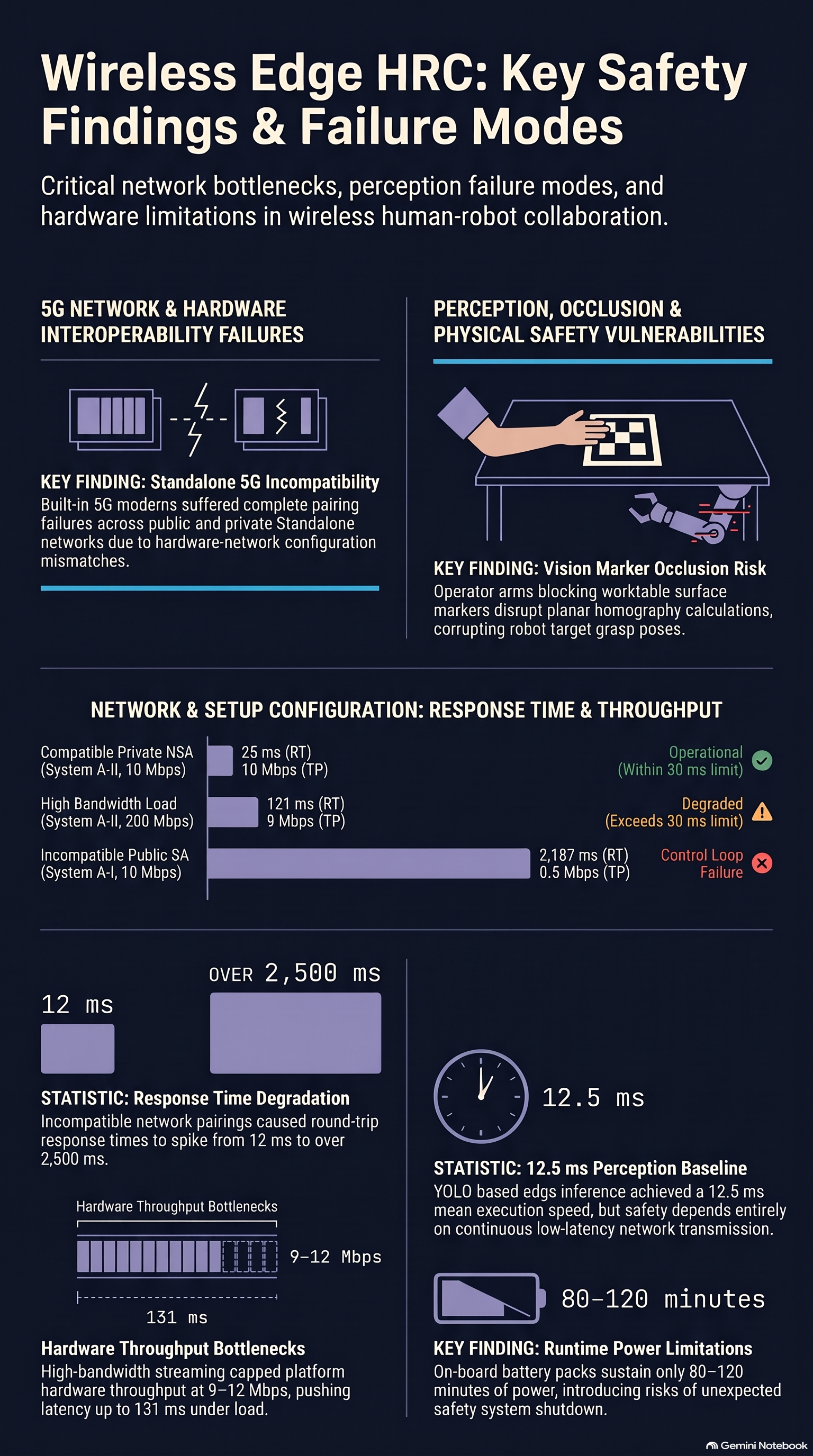
- Public SA Failure (System A-I): The multi-sensor platform’s built-in Quectel RM520N modem paired with the public SA network, but exhibited severe performance degradation. Round-trip latencies degraded to several seconds ( to ), and throughput stalled at , rendering real-time video offloading impossible.
- Private SA Drop Failure (System B): In the Norwegian private SA environment, the internal Quectel RM520N modem successfully established a network registration, but was repeatedly dropped by the base station, preventing sustained data transmission.
- Modem Fallback Workaround: To conduct stable network measurements, the authors were forced to connect the sensor node through an external COTS modem (ZTE MC 888)—the same unit utilized by the cobot controller and cell laptop.
- Edge Hardware Bottleneck (System A-II): Under high synthetic bandwidth loads (100 Mbps and 200 Mbps), the Trenz TE0821 SoM hardware interface became a processing bottleneck. While the private NSA network delivered full throughput to the cobot controller, the SoM capped platform throughput at (dropping to under Case #3 co-existing load conditions) and induced latency spikes up to .
| Test Scenario & Load | Measured KPI | System B Robot (Private SA) | System B Sensor (Private SA) | System A-I Robot (Public SA) | System A-I Sensor (Public SA) | System A-II Robot (Private NSA) | System A-II Sensor (Private NSA) |
|---|---|---|---|---|---|---|---|
| Case #1: Unloaded Baseline | MTU [B] | 1420 | 1420 | 1420 | 1420 | 1420 | 1420 |
| RT [ms] | 27 | 27 | 20 | 24 | 15 | 12 | |
| Case #2: 10 Mbps Target | RT [ms] | 19 | 25 | 2187 | 12 | 27 | 104 |
| JIT [ms] | 6 | 8 | 973 | 6 | 16 | 55 | |
| TP [Mbps] | 10 | 10 | 0.5 | 10 | 10 | 12 | |
| Case #2: 100 Mbps Target | RT [ms] | 15 | 23 | 2326 | 104 | 43 | 105 |
| JIT [ms] | 6 | 7 | 1083 | 55 | 21 | 54 | |
| TP [Mbps] | 99 | 100 | 0.5 | 12 | 100 | 12 | |
| Case #2: 200 Mbps Target | RT [ms] | 15 | 24 | 1324 | 105 | 52 | 108 |
| JIT [ms] | 5 | 7 | 2025 | 54 | 26 | 67 | |
| TP [Mbps] | 108 | 200 | 0.5 | 12 | 166 | 9 | |
| Case #3: 10 Mbps + Competing Load | RT [ms] | 19 | 27 | 2573 | 108 | 25 | 25 |
| JIT [ms] | 7 | 8 | 1675 | 67 | 14 | 14 | |
| TP [Mbps] | 10 | 10 | 0.5 | 9 | 10 | 10 | |
| Case #3: 100 Mbps + Competing Load | RT [ms] | 14 | 22 | 2192 | 131 | 40 | 121 |
| JIT [ms] | 4 | 8 | 1190 | 77 | 21 | 65 | |
| TP [Mbps] | 67 | 100 | 0.6 | 9 | 100 | 9 | |
| Case #3: 200 Mbps + Competing Load | RT [ms] | 14 | 25 | 2202 | 121 | 48 | 108 |
| JIT [ms] | 5 | 7 | 1159 | 65 | 23 | 14 | |
| TP [Mbps] | 81 | 198 | 0.6 | 9 | 163 | 10 |
5. Failure Mode & Boundary Analysis for AI Safety Researchers
The empirical findings presented by Takács et al. highlight important safety trade-offs when transitioning industrial control loops from hardwired lines to offloaded wireless edge networks. For red-teamers, embodied AI researchers, and safety engineers, the paper delineates clear physical and systemic failure modes:
1. Hardware/Network Interoperability Breakdown
While network operators and hardware vendors advertise standard 5G compliance, practical deployments reveal severe compatibility failures. As demonstrated by the built-in modem dropping off System B’s private SA network and stalling on System A-I’s public SA link, reliance on COTS modems for real-time safety vision can lead to unannounced network disconnects or extreme latency spikes (up to ). In a closed-loop HRC environment, a delay of this magnitude converts real-time motion suppression into an open-loop hazard, potentially leading to hard mechanical collisions before protective stop commands arrive over the link.
2. Perception Occlusion & Homography Degradation
The system’s vision pipeline projects image coordinates into 3D robot-space poses via planar homography derived from fixed worktable markers rather than continuous hand-eye calibration. If an operator’s body or arm occludes these reference markers during a workcell interaction, homography matrix calculation degrades or fails entirely. Because the architecture relies on visible fiducials for single-frame pose generation, marker occlusion acts as a single point of failure, corrupting target pose estimation and leading to inaccurate grasping trajectories or unintended robot movements toward the operator.
3. Power Exhaustion & Thermal Runtime Boundaries
Wireless modularity depends on battery power, which introduces operational run-time limits. The prototype platform sustained an operational lifespan of only 80 to 120 minutes under workload conditions where active video streaming was engaged 50% of the time. As battery voltage declines or thermal loads build near the SoM processing hardware, unmonitored systems risk abrupt dropouts or thermal throttling. Throttling reduces frame rates and video encoding efficiency, increasing latency in the safety monitoring loop.
6. Conclusion & Reader Takeaways
The study by Takács et al. validates the feasibility of cable-free, reconfigurable human-robot collaboration cells by combining flange-mounted sensor hardware, low-latency vision architectures, and 5G edge computing. Under compatible network configurations, the system achieved a steady-state perception latency of and wireless round-trip times down to , satisfying the timing constraints of adaptive industrial HRC.
However, the authors’ cross-border benchmarking demonstrates that wireless 5G technology has not yet reached full industrial maturity. Hardware interoperability mismatches, onboard processing bottlenecks under heavy traffic loads, and optical marker occlusion remain primary vulnerability vectors.
Key Takeaways for Technical Readers:
- Sub-15 ms Latency is Achievable but Conditional: Edge-offloaded vision pipelines can achieve steady-state inference speeds suitable for dynamic safety intervention ( on an RTX 4060 GPU), provided network-device pairings are fully optimized.
- 5G Device Interoperability Remains Unpredictable: Commercial 5G modems may fail to maintain stable connections or deliver expected bandwidth across different Standalone (SA) network configurations, requiring thorough site-specific validation.
- Hardware SoM Interfaces Can Limit Network Throughput: High network bandwidth capacity does not guarantee high throughput if the onboard System-on-Module bus processing architecture caps data ingest rates.
- Synthetic Compositing Yields High Safety Accuracy: Augmenting a 198-image in-cell baseline with segmented real-world hand samples over randomized real laboratory backgrounds produced exceptional binary hand presence detection ( F1-score), establishing a lightweight alternative to complex generative diffusion data pipelines.
- Multi-Sensor Power Boundaries Must Be Managed: Battery-powered perception nodes introduce strict operational limits (80–120 minutes of active operation), requiring hot-swappable battery hardware and active thermal management to prevent system instability.
Read the full paper on arXiv · PDF