Whisper-Aware LLM: Self-Supervised Uncertainty Learning for Robust Whispered Speech Recognition
The authors present Whisper-Aware LLM, a framework that couples self-supervised acoustic uncertainty learning with confidence-fused decoding to transcribe whispered speech while reducing noise...
1. Introduction: The Acoustic Dilemma of Whispered Speech
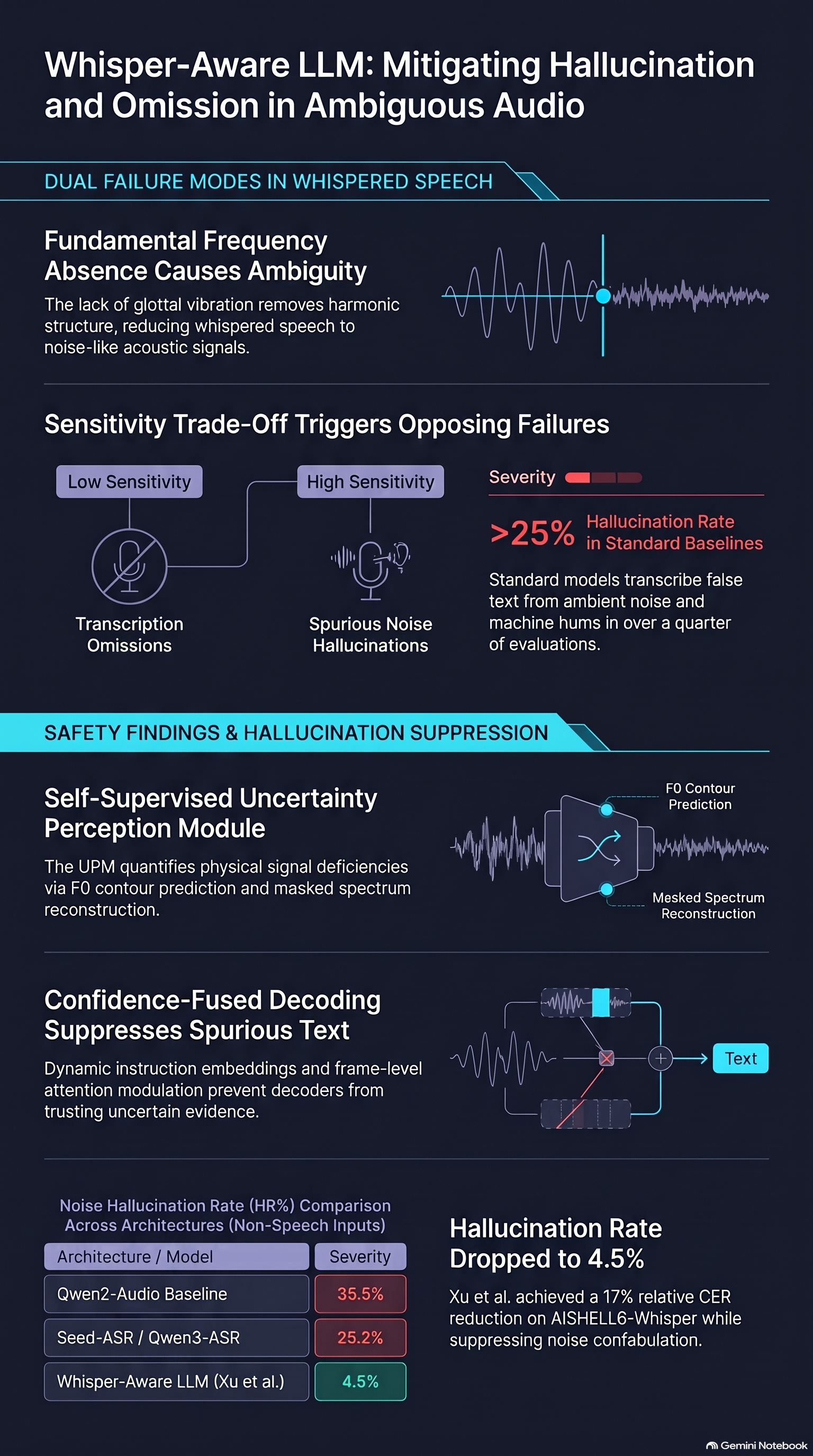
Whispered speech presents a long-standing acoustic challenge for Automatic Speech Recognition (ASR) systems and multimodal Audio-LLMs. Mechanistically, whispering is a mode of phonation that occurs without vocal fold vibration. This absence of glottal excitation eliminates the fundamental frequency () and harmonic structure characteristic of normal voiced speech, leaving a noise-like acoustic signature characterized by broad spectral diffusion and low energy.
When conventional Audio-LLMs and ASR models encounter whispered audio, this severe acoustic ambiguity triggers a systemic trade-off between sensitivity and reliability:
- Omission Errors: Models tuned primarily for standard voiced speech fail to perceive low-energy, unvoiced acoustic cues, leading to omitted words or entirely dropped transcription segments.
- Hallucination Errors: Conversely, increasing a model’s decoding sensitivity or context window to capture faint whispered speech heightens its vulnerability to confabulation. In these cases, the autoregressive text decoder over-interprets ambient background noise, erroneously transcribing non-speech signals into grammatically coherent but entirely spurious text.
To address this foundational reliability gap, researchers Gaopeng Xu, Zhenyu Wang, Zheng Xue, Yinfeng Xia, and Haitao Yao from the Qwen Business Unit at Alibaba introduced the framework “Whisper-Aware LLM: Self-Supervised Uncertainty Learning for Robust Whispered Speech Recognition”. The paper presents an architecture that explicitly quantifies physical acoustic uncertainty in real time and uses that signal quality assessment to dynamically guide the autoregressive LLM decoder.
2. Shifting Paradigms: Quantifying Uncertainty Before Decoding
Prior efforts to mitigate whisper-induced recognition degradation fall primarily into two paradigms, both exhibiting structural limitations:
- Data-Centric Augmentation: Generating synthetic “pseudo-whisper” training data via spectral transformations. While beneficial, these approaches are bounded by an inherent distributional gap between synthetic acoustic modifications and authentic whispered speech.
- Model-Centric Static Adaptation: Introducing static projection layers or adapter networks between the acoustic encoder and text decoder. These “one-size-fits-all” architectural additions apply fixed linear transformations across all inputs, failing to adapt dynamically to the continuum of signal degradation present in real-world audio.
A foundational acoustic study by Lin et al. established that the primary driver of performance degradation in whisper recognition is the explicit absence of glottal information (). Building upon this insight, Xu et al. shift the core modeling paradigm: rather than forcing an Audio-LLM to generate high-confidence textual predictions from highly uncertain inputs, a robust system must first explicitly quantify the signal’s intrinsic uncertainty before decoding begins.
+------------------+     +-------------------------------------------------+     +----------------------------+
|                  |     | Uncertainty Perception Module (UPM)             |     | Whisper-Aware LLM          |
|                  |     |                                                 |     |                            |
|                  |     |  [F0 Prediction (f_F0)] --------> h_conf(t) ----+---->| Self-Attention             |
|   Input Audio    |     |                                           (Bias)|     | (Attention Modulation)     |
|       (W)        |     |                                                 |     |                            |
|        |         |     |                                                 |     |                            |
|        v         |     |                                                 |     |                            |
|  Acoustic Enco.  |---->| Shared Extractor (1D-CNN + Trans.)              |     | LLM Decoder (D)            |
|       (E)        |     |                                                 |     |                            |
|                  |     |                                                 |     |                            |
|                  |     |  [Masked Spec. (f_Spec)] ------> u_global         |     |                            |
|                  |     |                                     |           |     |                            |
|                  |     |                                     v           |     |                            |
|                  |     |                                   (MLP)         |     |                            |
|                  |     |                                     |           |     |                            |
|                  |     |                                     v           |     |                            |
|                  |     |                                 e_instruct -----+---->| Input-Processor (System)   |
+------------------+     +-------------------------------------------------+     +----------------------------+
As depicted in the overall system architecture (Figure 1), the framework operationalizes this uncertainty-first strategy by coupling a lightweight Uncertainty Perception Module (UPM) with a Confidence-Fused Decoder. By explicitly isolating pitch deficiencies and structural noise before token generation begins, the architecture equips the underlying LLM to calibrate its decoding behavior dynamically.
3. Architecture Deep-Dive: The Uncertainty Perception Module (UPM)
The Uncertainty Perception Module (UPM) is a neural component designed to extract frame-level and sequence-level uncertainty metrics from the acoustic encoder’s output representations .
Structural Sublayers
The UPM processes encoder representations through a shared feature extractor comprising:
- Two 1D-Convolutional layers with GeLU activation functions for initial temporal downsampling and local feature aggregation.
- A single Transformer encoder layer designed to capture long-range temporal context across frame sequences.
The representations output by this shared extractor are fed into two task-specific auxiliary heads trained via self-supervised learning objectives.
Task 1: Contour Prediction
Because the loss of vocal fold vibration () is the primary acoustic marker of whispered speech, the first head () is trained to predict the continuous fundamental frequency contour directly from unlabelled acoustic representations . The auxiliary loss is calculated as the Mean Squared Error (MSE) relative to the ground-truth pitch contour :
The absolute frame-wise error directly measures localized pitch destruction. This error sequence is converted into a normalized frame-wise confidence score sequence :
where represents a predefined error clipping hyperparameter. Immediately following the clipping operation, the resulting sequence undergoes zero-centering across the temporal dimension to center confidence deviations around a neutral zero baseline.
Task 2: Masked Spectrum Reconstruction
To quantify unvoiced noise contamination and random spectral corruption, a second head () randomly masks spans of acoustic frames in and reconstructs the unmasked acoustic spectra via loss . The UPM’s final hidden state, averaged across the temporal dimension , yields a global uncertainty vector representing macro-level signal clarity.
4. Operationalizing Signal Quality: Confidence-Fused Decoding
Once extracted by the UPM, uncertainty signals are integrated into the autoregressive LLM decoder (built on Qwen-7B) through two complementary mechanisms operating at distinct granularities.
                  +-----------------------------------+
                  |  Uncertainty Perception Module    |
                  +-----------------------------------+
                       /                         \
      Global Vector (u_global)            Frame Confidence (H_conf)
                      |                              |
                      v                              v
           Instruction Embedding           Attention Modulation
               (e_instruct)                  (Additive Bias)
                      |                              |
                      v                              v
          +---------------------------------------------------+
          |            Confidence-Fused LLM Decoder           |
          +---------------------------------------------------+
Mechanism 1: Global Instruction Embedding ()
The temporal-averaged global uncertainty vector is processed by a Multi-Layer Perceptron () to project it into the LLM decoder’s hidden dimension:
This vector is prepended to the decoder’s prefix input sequence alongside standard audio/text embedding tokens. Functioning as a continuous system prompt, conditions the LLM’s initial hidden state on overall signal quality. This sets a macro-level decoding policy before token generation starts: when high global uncertainty is detected, the instruction shifts the LLM toward a conservative decoding state, raising the implicit threshold required to emit textual tokens.
Mechanism 2: Frame-Level Attention Modulation
To control frame allocation at micro-level temporal steps, the frame-wise confidence sequence is injected directly into the LLM decoder’s causal self-attention layers as an additive bias. When a query token computes an attention score against key token corresponding to acoustic frame , the scalar confidence score is modulated by a learnable parameter :
Mechanistically, when an unvoiced or noisy frame produces a high prediction error , its zero-centered frame confidence becomes negative. The additive term subtracts from the raw query-key dot product. When passed through the self-attention softmax operation, the resulting attention weight assigned to frame drops significantly. This prevents uninformative, noise-dominated acoustic frames from inflating decoder probabilities and generating confabulated text, forcing the LLM to rely on contextual linguistic priors or generate an empty output sequence when speech is absent.
Component Contributions (Ablation Analysis)
An ablation study conducted on the Chinese AISHELL6-Whisper benchmark highlights the individual contributions of these two confidence mechanisms:
| Configuration | Character Error Rate (CER %) |
|---|---|
| Baseline (Vanilla Fine-tuning) | 3.98% |
| + Frame-Level Attention Modulation Only | 3.45% |
| + Global Instruction Embedding Only | 1.84% |
| Full Model (Whisper-Aware LLM) | 1.31% |
The ablation data reveals that while frame-level attention modulation provides micro-level filtering (reducing CER by 0.53 percentage points), the Global Instruction Embedding is the single largest performance driver, dropping CER from 3.98% to 1.84%. This occurs because establishes the macro decoding state of the autoregressive decoder prior to token emission, whereas attention modulation acts as a fine-grained frame-filtering mechanism during sequence generation.
5. Disciplined Three-Stage Training Protocol
To integrate self-supervised uncertainty objectives without disrupting the pre-trained knowledge stored within the Qwen-7B backbone, Xu et al. structured a three-stage training pipeline.
Stage 1: UPM Pre-training (100k steps)
[ Freezes Audio-LLM ] ---> [ Trains UPM on L_F0 + L_Spec ]

Stage 2: Interface Adaptation (20k steps)
[ Freezes LLM Decoder ] -> [ Trains Encoder, Adapter, UPM, f_instr, w ]

Stage 3: Full End-to-End Fine-Tuning (20k steps)
[ Applies LoRA ] ---------> [ Joint Loss: L_ASR + λ_aux*(L_F0 + L_Spec) ]
Stage 1: UPM Pre-training
- Objective: Train the Uncertainty Perception Module independently on its self-supervised objectives () to ground uncertainty detection in acoustic physics.
- Status: The primary Audio-LLM backbone (encoder, adapter, decoder) remains completely frozen.
- Scale & Optimization: Executed for 100,000 steps using the AdamW optimizer with a learning rate of . The pre-training dataset comprises over 6,000 hours of general-purpose speech (a 3,000-hour subset of WenetSpeech, a 3,000-hour subset of GigaSpeech, AISHELL-1, and LibriSpeech), paired with whispered corpora (wTIMIT, AISHELL6-Whisper) and a dedicated 1,000-hour pure noise dataset.
Stage 2: Interface Adaptation
- Objective: Align multimodal feature spaces and train projection interfaces ( and scalar weight ).
- Status: The acoustic encoder, audio-LLM adapter, UPM, and interface parameters () are updated jointly, while the main Qwen-7B LLM decoder remains frozen.
- Scale & Optimization: Executed for 20,000 steps using AdamW () on the training splits of AISHELL-1, LibriSpeech, wTIMIT, AISHELL6-Whisper, and a 200-hour noise subset.
Stage 3: Full End-to-End Fine-Tuning
- Objective: Jointly optimize the entire pipeline using a combined loss function: where the auxiliary loss weighting hyperparameter is set to .
- Status: Parameter updates to the 7B LLM decoder are managed via Low-Rank Adaptation (LoRA: rank=64, alpha=32).
- Scale & Optimization: Executed for 20,000 steps using AdamW ().
6. Empirical Validation: Performance & Reliability Benchmarks
The authors evaluated the Whisper-Aware LLM across three primary dimensions: whispered speech recognition accuracy, hallucination resistance on non-speech inputs, and retention of standard ASR performance.
Whispered Speech Accuracy
On the official AISHELL6-Whisper benchmark, the Whisper-Aware LLM achieves a Character Error Rate (CER) of 1.31% on whispered speech, setting a new state-of-the-art benchmark and achieving a 17% relative error reduction over Seed-ASR (1.58%).
| Model | AISHELL6-Whisper Normal (CER %) | AISHELL6-Whisper Whisper (CER %) |
|---|---|---|
| S1: Whisper-v3 | 3.95% | 18.93% |
| S2: Whisper-v3 (Fine-tuned) | 1.62% | 6.69% |
| S3: Qwen2-Audio (Fine-tuned) | 1.05% | 3.98% |
| S4: AISHELL6-Whisper AVSR | 1.11% | 4.13% |
| S5: Qwen3-ASR | 0.64% | 3.79% |
| S6: Funasr-ASR | 0.72% | 19.50% |
| S7: Seed-ASR | 0.65% | 1.58% |
| Ours (Whisper-Aware LLM) | 0.63% | 1.31% |
On English benchmarks (wTIMIT split across US and Singaporean accents), the architecture demonstrates minimal performance degradation when moving from normal (N) to whispered (W) speech across accents:
| Model | WER (%) NUS | WER (%) NSG | WER (%) WUS | WER (%) WSG | CER (%) NUS | CER (%) NSG | CER (%) WUS | CER (%) WSG |
|---|---|---|---|---|---|---|---|---|
| S1: Whisper-v3 | 5.25 | 8.67 | 8.20 | 19.03 | 1.03 | 2.50 | 2.47 | 8.85 |
| S2: Whisper-v3 FT | 5.58 | 7.46 | 7.95 | 15.79 | 0.93 | 1.86 | 2.37 | 7.53 |
| S3: Qwen2-Audio FT | 4.95 | 6.85 | 7.40 | 13.50 | 0.88 | 1.65 | 2.30 | 6.20 |
| S4: AISHELL6 AVSR | 4.50 | 6.06 | 6.35 | 11.63 | 0.73 | 1.33 | 1.95 | 5.17 |
| S5: Qwen3-ASR | 4.99 | 7.26 | 7.01 | 16.46 | 0.98 | 1.85 | 2.45 | 7.11 |
| S6: Funasr-ASR | 4.65 | 6.96 | 8.48 | 19.29 | 0.91 | 1.76 | 2.88 | 8.24 |
| S7: Seed-ASR | 4.29 | 6.51 | 6.88 | 12.95 | 0.85 | 1.62 | 2.15 | 6.03 |
| Ours (Whisper-Aware) | 4.15 | 5.89 | 5.92 | 10.81 | 0.70 | 1.25 | 1.85 | 4.98 |
Hallucination Mitigation under Extreme Noise
To test decoding reliability on out-of-distribution unvoiced audio, the authors constructed a 1,000-clip Noise Hallucination Set. This set contains non-speech audio (e.g., wind noise, machine hum) and heavily obscured audio segments. These clips were specifically designed to be challenging for conventional Voice Activity Detectors (VADs) and prone to trigger false transcriptions in standard ASR decoders. Reliability is measured by the Hallucination Rate (HR%), defined as the percentage of unvoiced clips that generate a non-empty transcription.
| Model | Hallucination Rate (HR %) |
|---|---|
| S3: Qwen2-Audio (Fine-tuned) | 35.5% |
| S5: Qwen3-ASR | 25.2% |
| S6: Funasr-ASR | 29.3% |
| S7: Seed-ASR | 25.2% |
| Ours (Whisper-Aware LLM) | 4.5% |
While baseline models hallucinated non-existent text on 25.2% to 35.5% of non-speech clips, the Whisper-Aware LLM suppressed spurious generations down to 4.5%.
General ASR Competency Preservation
Evaluations on standard voiced speech datasets confirm that integrating self-supervised uncertainty heads does not compromise base ASR performance:
| Model | AISHELL-1 Normal (CER %) | LibriSpeech-clean Normal (WER %) |
|---|---|---|
| Whisper-v3 | 4.72% | 1.86% |
| Seed-ASR | 1.63% | 2.80% |
| Funasr-ASR | 1.22% | 1.51% |
| Ours (Whisper-Aware LLM) | 1.34% | 1.91% |
7. Strategic Takeaways for AI Safety and Audio-LLMs
- Physics-Grounded Uncertainty Estimation as a Defense Against Hallucination: Relying exclusively on supervised sequence-to-sequence loss encourages multimodal decoders to fit spurious correlations when inputs lack informative structure. By grounding auxiliary tasks in physical signal attributes (such as pitch tracking and spectral reconstruction), multimodal architectures learn to recognize degraded inputs and suppress confabulation.
- Dual-Granularity Generative Control: Signal degradation manifests across multiple temporal resolutions. Coupling macroscopic instruction embeddings () with localized self-attention score adjustments () enables autoregressive models to combine global prompt conditioning with frame-level filtering.
- Red-Teaming Perceptual Boundaries in Audio-LLMs: For AI safety red-teamers, the paper highlights how unvoiced audio and noise segments that evade standard VAD filters can be systematically leveraged to test whether multimodal systems break gracefully (emitting empty output sequences) or fail catastrophically (generating hallucinated text). Executing controlled noise injection and masked acoustic probes provides an empirical framework for evaluating reliability in perceptual LLM architectures.
Read the full paper on arXiv · PDF